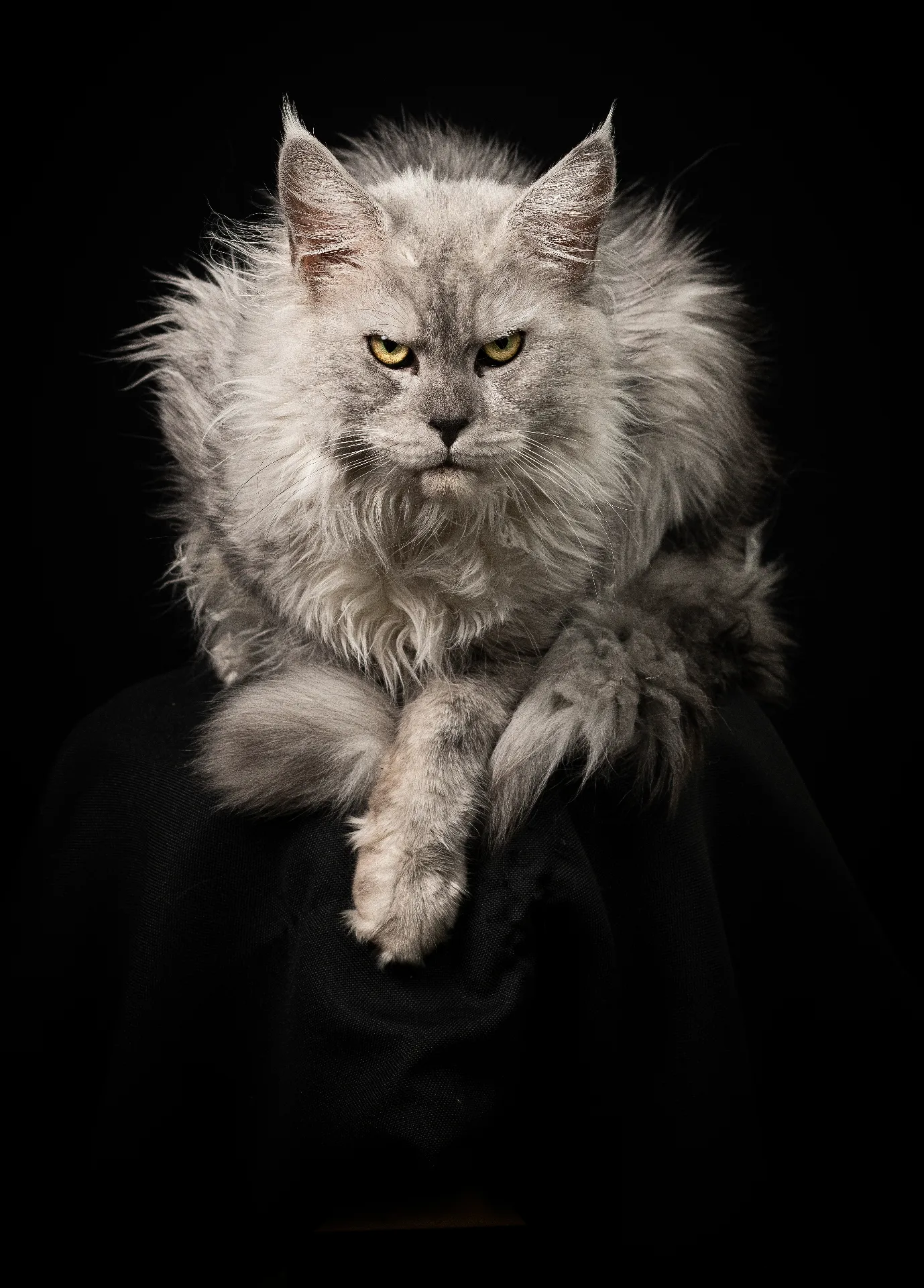
I get asked this constantly: "What's the difference between a Maine Coon and a Norwegian Forest Cat?" I've met both breeds at TICA shows, studied their pedigrees, and I chose Maine Coons for Chatlerie for very specific reasons. The breeds share ancestors — but living with them is a completely different experience. Here's how to tell them apart and why I breed the one I breed.
The Quick Visual Comparison
| Feature | Maine Coon | Norwegian Forest Cat (Wegie) |
|---|---|---|
| Head shape | Wedge-shaped, high cheekbones, square muzzle | Triangular/equilateral, straight profile, no break in nose |
| Profile | Slight concave curve from forehead to nose | Absolutely straight nose profile — the definitive identifier |
| Muzzle | Strong, square, prominent. Often described as "boxy." | Narrower, tapering. More refined and pointed. |
| Ears | Large, set wide apart, lynx tips (ear tufts extending from tip) | Large, set at corners of head. Interior ear furnishings but shorter tip tufts. |
| Eyes | Large, oval to slightly oblique. Wide range of colors. | Large, almond-shaped. Set at slight angle following head shape. |
| Body | Rectangular, muscular, heavy-boned. Massive chest. | Solid and muscular but slightly less massive than Maine Coon. |
| Tail | Long, thick from base, dramatically plumed | Long, bushy, carried high. Fuller at base of spine. |
| Coat texture | Silky, flowing, minimal undercoat compared to NFC | Dense, woolly undercoat. More "winter coat" texture. |
| Adult male weight | 15–25 lbs | 12–18 lbs |
The One Feature That Never Lies: The Profile
If you remember nothing else from this guide, remember this: look at the profile from the side.
A Norwegian Forest Cat has a perfectly straight nose line from the top of the forehead to the tip of the nose — no curves, no breaks, no concavity. This straight profile is a breed standard requirement and a reliable identifier even in mixed ancestry.
A Maine Coon has a slight concave curve — a gentle "ski-slope" between the forehead and the nose. Combined with the square, prominent muzzle, this creates a face that looks more three-dimensional and substantial than the NFC's more refined triangle.
Turn the cat to the side. If the nose profile is perfectly straight like a right angle, you're looking at a Norwegian Forest Cat. If there's a gentle curve, you're likely looking at a Maine Coon.
Coat: Similar at a Glance, Very Different in Feel
Both breeds have impressive long coats. But they feel remarkably different in your hands:
- Norwegian Forest Cat: Dense, woolly undercoat with long, coarser guard hairs. Water-resistant to an extraordinary degree — legends say Wegies could shake water from their coats like a dog. The coat feels fuller and more insulating in winter.
- Maine Coon: Silkier, more flowing coat. Less dense undercoat. The guard hairs are longer and have a more luminous quality. The belly "shag" and neck ruff are among the most dramatic in any cat breed.
Grooming maintenance is roughly equivalent — both need weekly brushing and occasional baths. Norwegian Forest Cats may shed more heavily during seasonal transitions due to the denser undercoat.
Temperament: Where They Really Diverge
Both breeds are social, intelligent, and good with families. But their personalities have distinct flavors:
| Trait | Maine Coon | Norwegian Forest Cat |
|---|---|---|
| Social style | Active participant — follows you, initiates interaction, wants to be involved | Social but more independent — affectionate on their terms |
| Dog-like qualities | Very strong — fetch, following owner room to room, greeting at door | Less dog-like; more classically cat-independent |
| Vocalizations | Very vocal — chirps, trills, and extensive communication | Quieter generally; less likely to "talk" consistently |
| With strangers | Usually curious and social even with new people | More cautious initially; warms up but on their timetable |
| Play style | Intense and interactive; loves games involving humans | Strong hunter instinct; excellent solo play drive |
| Lap preferences | Variable — many Maine Coons prefer to be near you rather than on you | Often more selective about physical contact; quality over quantity |
Health Considerations
Both breeds have breed-specific health concerns worth knowing:
Maine Coon
- HCM (Hypertrophic Cardiomyopathy): The primary health concern in Maine Coons. Annual echo screening by a cardiologist is standard in responsible breeding programs.
- Spinal Muscular Atrophy (SMA): Genetic condition affecting motor neurons; DNA testing available and responsible breeders test for it.
- Hip dysplasia: More common in Maine Coons than most cat breeds due to their size. Usually manageable; OFA screening available.
Norwegian Forest Cat
- Glycogen Storage Disease Type IV (GSD IV): A fatal metabolic condition; DNA testing available. Responsible Wegie breeders test for it.
- HCM: Also present in Wegies, though at lower prevalence than in Maine Coons. Annual screening is still recommended.
- Retinal Dysplasia: Eye condition seen in some Wegie lines; genetic testing available.
Which Breed Is Right for You?
This is the question that matters most, and the honest answer depends on your life:
Choose a Maine Coon if:
- You want a cat who actively seeks your company and involves themselves in your day
- You love a vocal cat who communicates expressively
- You have children or dogs and want a sociable, adaptable companion
- You want the absolute maximum in size and physical presence
- You want a cat you can train, walk on a leash, and take on adventures
Choose a Norwegian Forest Cat if:
- You appreciate a cat who is affectionate but on their own schedule
- You prefer a quieter presence who doesn't follow you everywhere
- You live in a colder climate and want a cat bred for extreme weather
- You love the perfectly triangular Nordic aesthetic
- You want a cat with extremely strong independent hunting instincts
If you've decided Maine Coon is your breed, we'd love to meet you.
Start My Application →