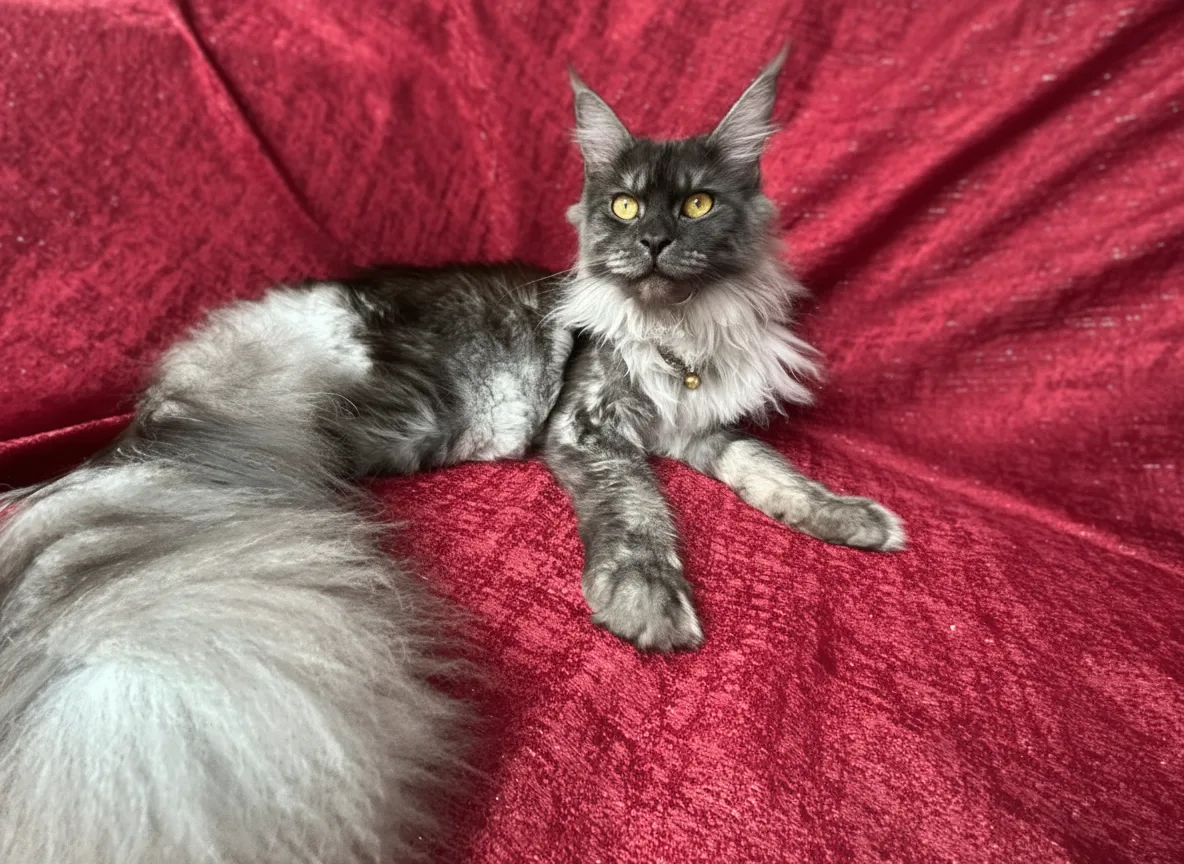
I live with five Maine Coons. Euro follows me from room to room like a 24-pound shadow. Coco brings me toys and drops them at my feet — then stares at me until I throw them. Libra chirps every single time I walk past her. These aren't marketing descriptions. This is Tuesday at my house. Here's what Maine Coon temperament actually looks like when you live with these cats every day.
The Dog-Like Behaviors That Surprise New Owners
The comparison to dogs is made so often that it's become a cliché — but it's accurate enough to be worth unpacking. Maine Coons don't behave like cats who merely tolerate humans. They behave like animals who have genuinely chosen to be with you.
They follow you room to room. Not occasionally. Consistently. Your Maine Coon will be wherever you are in the house. They'll wait outside the bathroom. They'll relocate their nap to whichever room you're working in. This is not neediness — it's companionship. There's a significant difference.
They greet you at the door. Not sometimes, when they happen to be nearby. They recognize the sound of your car, your footsteps, your key in the lock — and they'll be waiting. Some Maine Coon owners describe this as the single most disarming thing about the breed, especially those who have only owned less social cats.
Many play fetch. Not trained fetch. Spontaneous, self-initiated fetch, where they bring a toy to you, drop it at your feet, and wait. This behavior emerges naturally in a significant percentage of Maine Coons with no training required. It's one of the behaviors that makes first-time owners question whether they accidentally adopted a small dog.
They respond to their name. Most cats know their name. Maine Coons actually respond to it — turning their head, chirping back, or coming to you when called. Training recall is genuinely possible with this breed, which is remarkable in the cat world.
The first time your Maine Coon brings a toy to your feet, drops it, and looks at you expectantly, you'll understand why their owners become the most devoted cat people on earth.
Core Temperament Traits
The Maine Coon Voice
If you've only heard regular domestic cat meows, your first Maine Coon trill will be a surprise. The breed has a distinctive rolling chirp-trill that sounds more like a songbird than a cat. They use it as a greeting, an expression of happiness, and a commentary on whatever is happening in front of them. Many owners report conversations with their Maine Coons — call and response exchanges that go on for minutes.
They also maintain the full cat vocalization range — meows for requests, chirps for bird-watching, and the silent meow (mouth open, no sound) that they reserve exclusively for their favorite person. If your Maine Coon gives you a silent meow, you've earned something significant.
Social Dynamics at Home
With other cats
Maine Coons are typically excellent with other cats when properly introduced. Their confident, gentle nature means they rarely start conflicts. They'll often become the social anchor of a multi-cat household — the calm center around which more anxious cats gradually settle. A proper introduction protocol (two weeks minimum) is still essential, but the outcome is usually positive.
With dogs
The breed's dog-like social orientation means they often form genuine friendships with dogs. Many Maine Coon and dog pairs become inseparable. The key is the dog's disposition and the quality of the introduction — a Maine Coon who feels safe will be curious about a dog rather than afraid. A Maine Coon who is rushed into contact with a reactive dog will take months to recover trust.
With children
Maine Coons and children are one of the great natural pairings in the animal world. Their patience, play drive, and size (large enough that young children don't injure them accidentally) make them exceptional family cats. They almost never scratch in frustration — they simply remove themselves from situations they're uncomfortable with. This self-regulation is rare and valuable.
With strangers
Most Maine Coons don't hide when guests arrive. They investigate. Some come immediately for attention. Others observe from a dignified distance before deciding the visitor is acceptable. Very few retreat to under-the-bed and stay there — that level of social anxiety is not characteristic of a well-bred, well-socialized Maine Coon.
European vs. American Maine Coon Temperament
While the core breed traits are consistent, European Maine Coons from quality bloodlines tend to exhibit an even more pronounced social orientation than American-lineage cats. European breeders have historically placed significant emphasis on temperament in their selection criteria alongside conformation. The result is a cat that's not just physically larger and more dramatic-looking, but often more consistently social, curious, and adaptable.
At Chatlerie, we see this consistently in our own litters — kittens who are already confidently exploring, engaging with human visitors, and exhibiting clear personalities by week five. This is not accidental. It's the result of intentional selection over generations combined with an intensive socialization program from the earliest weeks of life.
What Maine Coon Temperament Means for Ownership
The same qualities that make Maine Coons extraordinary also mean they require genuine engagement. A Maine Coon left alone for extended periods will express their boredom — through vocalization, through creative problem-solving (sometimes involving your belongings), and through a general diminishment of the joy that makes the breed worth having in the first place.
They are not low-maintenance cats emotionally. They are cats who want to be part of your life — not observed from across the room, but actively included. Daily play sessions, conversation, and physical proximity are not optional extras for this breed. They are the whole point.
Maine Coon Temperament: The Quick Reference
- Dog-like loyalty — follows you, greets you, responds to their name
- High intelligence — problem solvers, trainable, endlessly curious
- Strong play drive that persists well into adulthood
- Gentle and patient with children, other pets, and strangers
- Vocal with a distinctive trill; communicates constantly with their people
- Confident and secure — not anxious, not aloof, not demanding
- Requires daily engagement — this is not a decorative cat
- European bloodlines tend toward even stronger social orientation