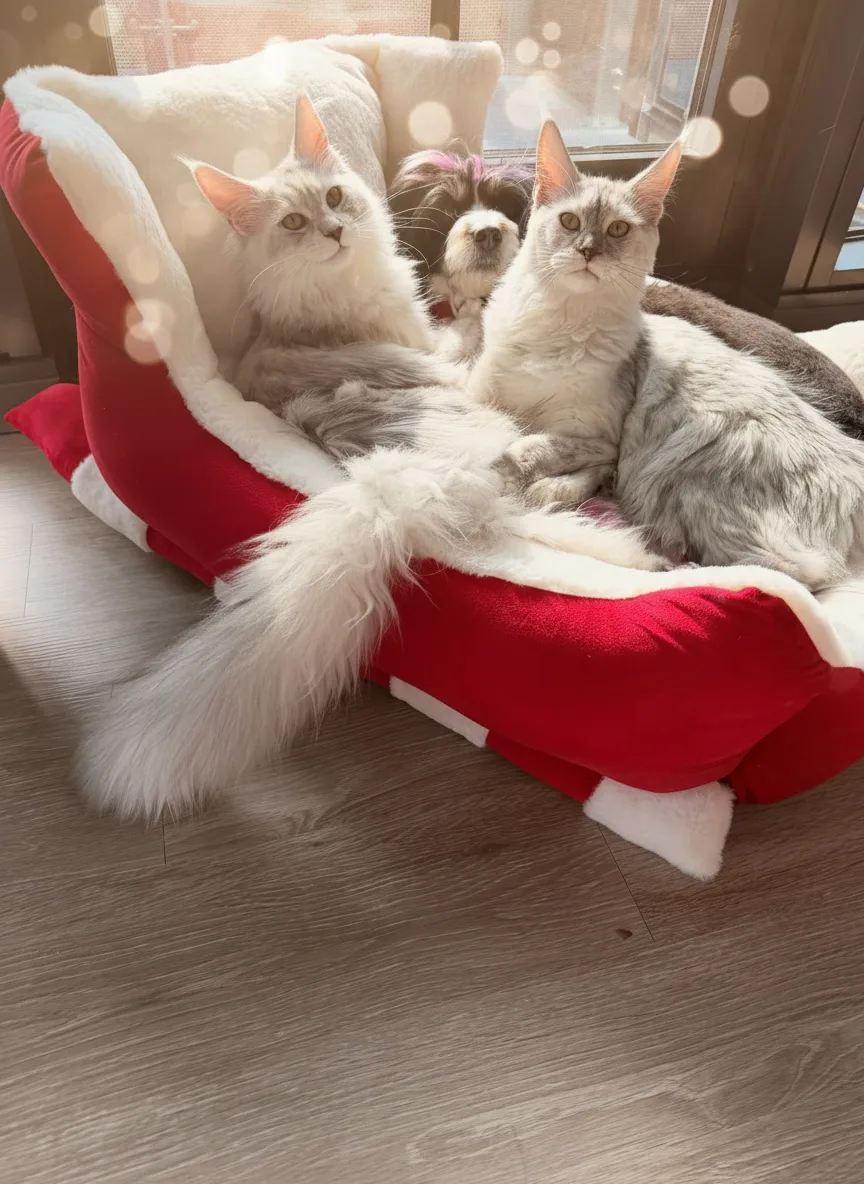
I groom five Maine Coons. Euro's thick brown tabby coat needs a different approach than Libra's fine white fur. Coco's blue smoke pattern hides tangles until they're mats. I've learned all of this the hard way — and every Chatlerie kitten goes home having been groomed from day one so the habit is already built. Here's exactly what works.
Understanding the Maine Coon Coat
The Maine Coon's coat evolved for survival in the harsh winters of northeastern America — it is not an aesthetic accident. It consists of three distinct layers:
- Guard hairs: The long outer layer. Slightly water-resistant. Gives the coat its silky, flowing appearance.
- Awn hairs: The middle layer. Provide insulation and body.
- Undercoat: Dense, soft, and the primary matting culprit. Dead undercoat that doesn't shed properly becomes tangled with the awn and guard layers.
Unlike Persian coats (which mat almost immediately), Maine Coon fur has a semi-water-resistant quality and a texture that resists tangling in well-maintained cats. The key phrase: well-maintained. A Maine Coon who is groomed weekly from kittenhood is fundamentally different to groom than one who wasn't.
The Weekly Grooming Ritual: Step by Step
Schedule the same time each week. Consistency builds trust faster than anything else. A 15-minute session is sufficient for a well-maintained coat. Start when your kitten is slightly tired — after play, not before.
Step 1: The Slicker Brush (5 minutes)
Start at the back of the neck, working toward the tail in the direction of hair growth. Use short, gentle strokes. Don't press hard — you want to catch loose undercoat, not rake the skin. Work along the sides, then lightly over the belly (if tolerated). The slicker brush is your primary mat-prevention tool.
Step 2: The Steel Comb (5 minutes)
Follow the brush with a wide-tooth steel comb through the three mat-prone zones: behind the ears, the armpits, and the belly/pants area. The comb reaches deeper than the brush and will find developing mats before they become problems. Work slowly and gently. If you find resistance, do not pull — hold the base of the fur and work the comb from the tip inward toward the mat.
Step 3: Nail Trim (3 minutes)
Hold the paw gently and press the pad to extend the claw. You're looking for the transparent portion above the pink quick. Clip just the curved transparent tip. If your kitten pulls back sharply, you've gone too close. Front paws every two weeks; back paws monthly. If you nick the quick and it bleeds, apply a tiny amount of styptic powder or cornstarch — it stops immediately.
Step 4: Ear Check (2 minutes)
Look into each ear with a flashlight if needed. You're checking for: dark brown/black crumbly debris (ear mites — call your vet), unusual redness or swelling (infection), or excessive wax buildup. A small amount of light-brown wax is completely normal. Do not insert anything into the ear canal.
The Three Mat-Prone Zones — Check These Every Grooming
- Behind the ears: Friction from head movement creates mats here in as little as 48 hours on neglected coats. Comb through gently at every session.
- Armpits (front leg joins): Constant movement creates tangles fast. These are the mats most likely to become tight and require professional removal.
- Belly, groin, and "pants": Longer fur in these areas catches debris and knots during litter box use. Check carefully — these mats hide well.
Bathing Your Maine Coon
Most Maine Coons need a bath every 4–6 weeks. Unlike most breeds, many Maine Coons genuinely tolerate — and some enjoy — water. Their guard hairs have a naturally water-resistant quality, and there's compelling evidence that the breed descends from Norwegian Forest cats brought to North America by early sailors, who selected cats comfortable around water.
That said, not every Maine Coon loves a bath. The goal is neutral tolerance, achieved through repeated positive associations starting in kittenhood.
First Bath Protocol (for kittens)
- Fill the sink or tub with 2–3 inches of warm water (not hot) before bringing the kitten in
- Use a non-slip mat — a sliding kitten becomes a panicked kitten
- Wet gently from the back forward, avoiding eyes and ears
- Use a cat-specific shampoo (human shampoo pH will irritate their skin)
- Rinse thoroughly — residue causes skin irritation
- Have high-value treats ready and give them immediately after
- Keep the first bath under 5 minutes
Drying: The Part Everyone Gets Wrong
The Maine Coon coat holds moisture deep in the undercoat long after the guard hairs feel dry to the touch. Never leave a Maine Coon air-drying in a cool or drafty environment. Moisture trapped near the skin causes bacterial dermatitis. Use absorbent towels first, then a pet-specific high-velocity dryer or a human hair dryer on the lowest heat setting, held at least 6 inches from the coat. Brush while drying to prevent the coat from drying in clumps.
Dealing With Mats
Mats happen — even in well-groomed cats, especially during seasonal shedding. How you handle them matters enormously.
Never cut a mat with scissors. Cat skin is very thin and loosely attached to the body — it tents up into the mat in a way that makes skin lacerations nearly inevitable. Professional groomers see scissor injuries from well-meaning owners regularly. Use a dematting comb or a mat splitter tool instead. If the mat is tight to the skin, take your cat to a professional groomer and tell them you cannot get a comb under it.
Dematting Technique
- Step 1: Hold the base of the fur firmly between two fingers close to the skin. This prevents pulling.
- Step 2: Apply a small amount of detangling spray or coconut oil to the mat.
- Step 3: Work the mat splitter or comb from the outside tip inward, working in small sections.
- Step 4: Never force. If the mat doesn't move with reasonable pressure, stop and see a groomer.
Seasonal Grooming: Illinois-Specific Considerations
Illinois's dramatic seasonal shifts affect Maine Coon grooming significantly. The two major coat transitions — spring shedding and fall coat growth — require adjusted grooming frequency.
| Season | Coat Behavior | Grooming Adjustment |
|---|---|---|
| Spring (March–May) | Heavy undercoat shedding; loosening of winter coat | Increase brushing to daily or every other day. Use a de-shedding tool (Furminator on lowest setting). |
| Summer (June–Aug) | Lighter coat; natural thinning | Weekly maintenance sufficient. Watch for knots forming in reduced-density zones. |
| Fall (Sept–Nov) | Winter coat growing in; dense undercoat developing | Begin increasing sessions to twice weekly as coat thickens. |
| Winter (Dec–Feb) | Full winter coat; maximum density and length | Weekly minimum. Humidity from indoor heating dries coat — consider a humidifier. |
When to See a Professional Groomer
Professional grooming every 8–12 weeks is an excellent complement to your home grooming routine — not a substitute for it. A good cat groomer can: do a full sanitary trim (belly and hindquarters), remove mats that are too tight for home treatment, provide a thorough bath and blow-dry, and give you a fresh baseline coat to maintain from.
When evaluating a groomer, ask specifically about their experience with Maine Coons and double coats. Not all groomers are experienced with large, long-coated breeds, and a bad grooming experience in kittenhood can make future grooming significantly harder.
Questions about grooming your Chatlerie kitten? We're here.
Contact The Chatlerie →