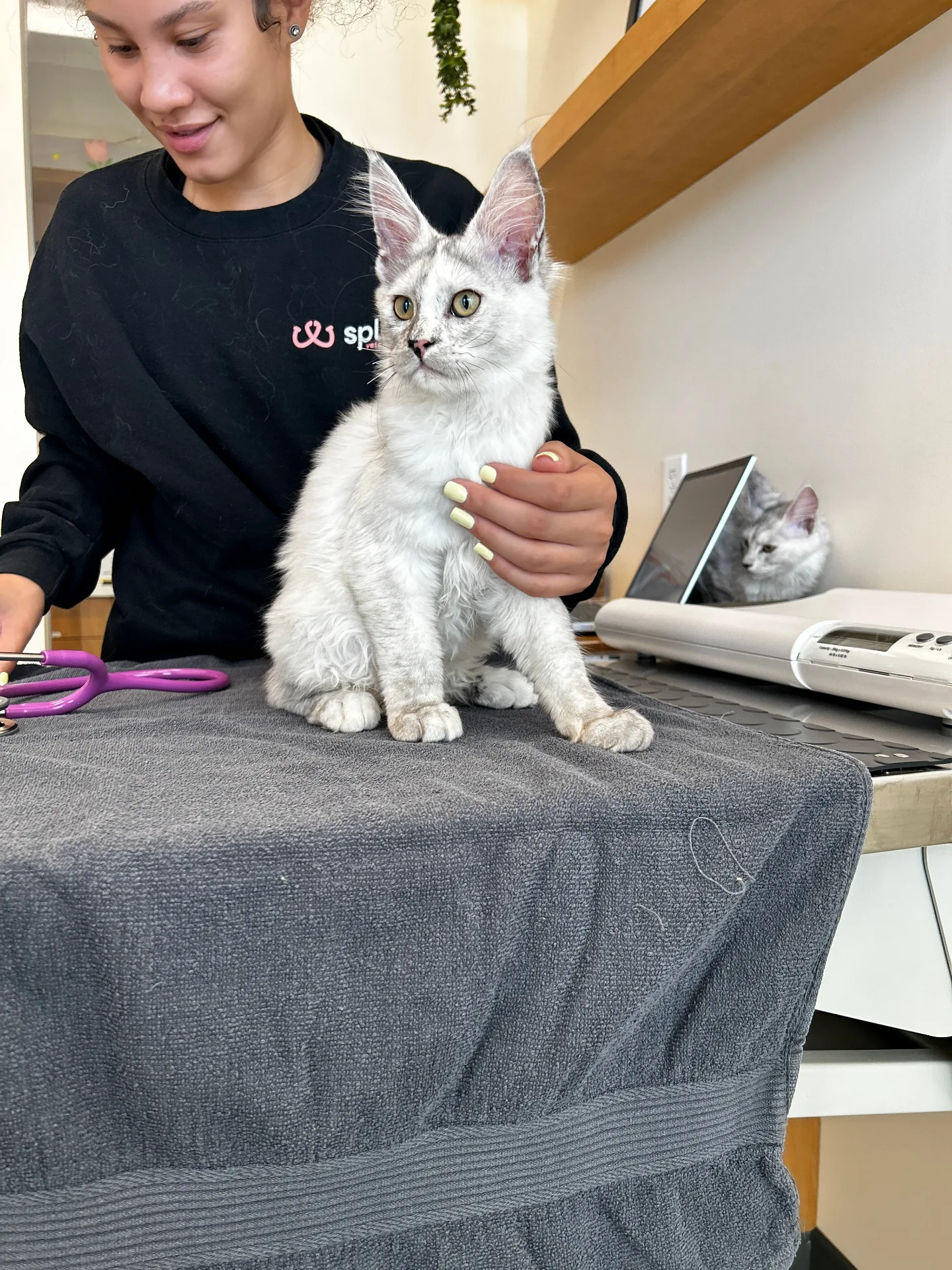
I echocardiogram every one of my breeding cats — Euro, Coco, Libra, Angel, and Eddie — every single year, without exception. It costs me thousands of dollars annually. Some breeders think I'm crazy. I think they're gambling with their kittens' lives. Health testing is the hill I will die on, and this guide explains every test a responsible breeder should perform, what it detects, and why cutting corners here is the most expensive mistake an Illinois buyer can make.
When I say I'm "selling years, not kittens" — this is what I mean. A 3-year health guarantee only works if you've done the testing to back it up. Here's the complete playbook.
HCM Screening — The #1 Non-Negotiable
Hypertrophic Cardiomyopathy (HCM) is the leading cause of death in Maine Coons. It causes thickening of the heart muscle, which can lead to heart failure, blood clots, and sudden cardiac death — sometimes with no prior symptoms.
How HCM Testing Works
The gold standard for HCM screening is an echocardiogram — a cardiac ultrasound performed by a board-certified veterinary cardiologist (DACVIM-Cardiology). Not a general practice vet. Not a technician. A board-certified cardiologist.
The echocardiogram measures the thickness of the heart walls and septum in real time. It can detect early-stage HCM before any clinical symptoms appear — allowing breeders to remove affected cats from their breeding program.
"DNA testing for the MyBPC3 mutation is a useful screening tool, but it is not a substitute for echocardiographic evaluation. HCM in Maine Coons is polygenic — multiple genetic variants contribute. Annual echocardiographic screening of all breeding cats remains the gold standard." — Dr. Kathryn Meurs, DVM, PhD, DACVIM, NC State University
How Often Should Breeders Test?
Annually. HCM can develop at any age — a cat that scans clear at age 2 may develop HCM at age 4. Responsible breeders echocardiogram every breeding cat every year, without exception.
🚩 HCM Red Flags
- Breeder says "We do DNA testing for HCM" — DNA alone is insufficient
- Breeder says "Our cats have never had HCM" but doesn't echocardiogram
- Echocardiogram performed by a general practice vet, not a cardiologist
- No echocardiogram results available, or results older than 12 months
Full Genetic Panel — Wisdom Panel / Optimal Selection
A comprehensive genetic panel screens for 45+ hereditary conditions in a single test. The two most widely used panels for Maine Coons are Wisdom Panel (Mars Veterinary) and Optimal Selection (also Mars). Both use DNA from a simple cheek swab.
Key Conditions Screened
| Condition | What It Is | Why It Matters |
|---|---|---|
| MyBPC3 (HCM mutation) | Known genetic variant linked to HCM | Positive cats should be bred cautiously or retired |
| PKD (Polycystic Kidney Disease) | Cysts form in kidneys, leading to renal failure | Common in Persians; occasionally found in Maine Coons |
| SMA (Spinal Muscular Atrophy) | Progressive muscle weakness from spinal nerve degeneration | Carriers show no symptoms but can produce affected kittens |
| PK-Def (Pyruvate Kinase Deficiency) | Red blood cell enzyme deficiency causing anemia | Carriers are healthy but two carriers = 25% affected kittens |
| Factor XI Deficiency | Blood clotting disorder | Can cause excessive bleeding during surgery |
| Blood Type (A/B/AB) | Determines blood compatibility | Critical for safe breeding — type B queens with type A kittens can cause neonatal isoerythrolysis |
At Chatlerie, every breeding cat undergoes full Wisdom Panel testing. Results are documented and available to any adopting family who requests them. Transparency isn't optional — it's the foundation of responsible breeding.
🧬 What "carrier" means
A cat that carries one copy of a recessive mutation is a carrier — healthy themselves, but able to pass the mutation to offspring. Responsible breeders never pair two carriers of the same condition. This is why full genetic panels on both parents matter.
FeLV and FIV Testing
Feline Leukemia Virus (FeLV) and Feline Immunodeficiency Virus (FIV) are contagious retroviruses that compromise the immune system. Both are transmitted through close contact — saliva, grooming, shared food bowls, and bite wounds.
Testing Protocol
FeLV/FIV Requirements
- All breeding cats tested negative before entering the breeding program
- All kittens tested before going to their new homes
- Testing performed via SNAP test (ELISA) at a licensed veterinary clinic
- Positive cats permanently removed from breeding and isolated from other cats
FeLV/FIV testing is the simplest, cheapest, and most straightforward test on this list — which is exactly why there is zero excuse for any breeder to skip it.
Vaccinations and Deworming
While not "genetic testing," vaccinations and parasite prevention are essential components of a kitten's health profile at go-home.
| Vaccine/Treatment | When | Notes |
|---|---|---|
| FVRCP (core vaccine) | 6, 10, and 14 weeks | Protects against feline distemper, calicivirus, rhinotracheitis |
| Rabies | 12–16 weeks | Required by law in most states including Illinois |
| Deworming | 2, 4, 6, 8 weeks | Routine protocol for all kittens |
| Flea/tick prevention | 8+ weeks | Applied before go-home |
At Chatlerie, every kitten leaves with a complete vaccination record, veterinary health certificate, and documentation of all treatments received. The go-home packet includes a detailed schedule for the new family's veterinarian to continue the kitten's care seamlessly.
The Health Guarantee: Putting Testing Into Writing
Health testing means nothing if the breeder doesn't stand behind their kittens with a written guarantee. The guarantee is the contract that says: "I tested my cats, I'm confident in the results, and I'll back that confidence with my own money if something goes wrong."
| Guarantee Length | What It Signals | Industry Context |
|---|---|---|
| No guarantee | 🚨 Major red flag | Avoid completely |
| 1 year | Minimum acceptable standard | Covers most congenital defects |
| 2 years | Above average commitment | Covers late-onset genetic conditions |
| 3 years (Chatlerie) | Industry-leading confidence | Covers HCM and genetic conditions through maturity |
| 5+ years / Lifetime | Rare; verify terms carefully | May have extensive exclusions |
Chatlerie offers a 3-year health guarantee — the longest of any Maine Coon breeder in Illinois. This extended guarantee reflects the depth of our health testing program: when you test thoroughly and breed responsibly, you can afford to guarantee your kittens longer because you've already minimized the risk.
The Complete Health Testing Checklist
Print this. Save it. Bring it to every conversation with a Maine Coon breeder. Every item should be a "yes" before you pay a deposit.
✅ The Checklist
- Annual HCM echocardiogram by board-certified cardiologist (DACVIM) — both parents
- Full genetic panel (Wisdom Panel or Optimal Selection) — both parents
- FeLV/FIV negative test results — all breeding cats and all kittens
- Complete FVRCP vaccination series (minimum 2 rounds before go-home)
- Rabies vaccination (if age-appropriate)
- Deworming protocol completed
- Written health guarantee — minimum 1 year, ideally 2–3 years
- Veterinary health certificate at go-home
- TICA registration papers with documented pedigree
- Microchip with registration transfer documentation
- Results available proactively — not just "upon request"
✅ Chatlerie's Standard
Every item on this checklist is standard for every Chatlerie kitten — no exceptions, no "upon request," no additional fees. Health testing is not a premium feature. It's the baseline.
Questions to Ask Your Breeder About Health Testing
Ask These Questions
- Can I see the most recent HCM echocardiogram for both parents of my kitten's litter?
- Who performed the echocardiogram? Are they board-certified in cardiology?
- What genetic panel do you use? Can I see the results for both parents?
- Are any of your breeding cats carriers for any genetic conditions?
- What does your health guarantee specifically cover?
- What happens if my kitten develops a genetic condition within the guarantee period?
- Do you test for FeLV and FIV? Can I see the results?
- What vaccinations will my kitten have received before go-home?
- Will I receive a veterinary health certificate at go-home?
A great breeder will answer every one of these questions openly, immediately, and without defensiveness. If a breeder hesitates, redirects, or says "we don't share that information" — that tells you everything you need to know.