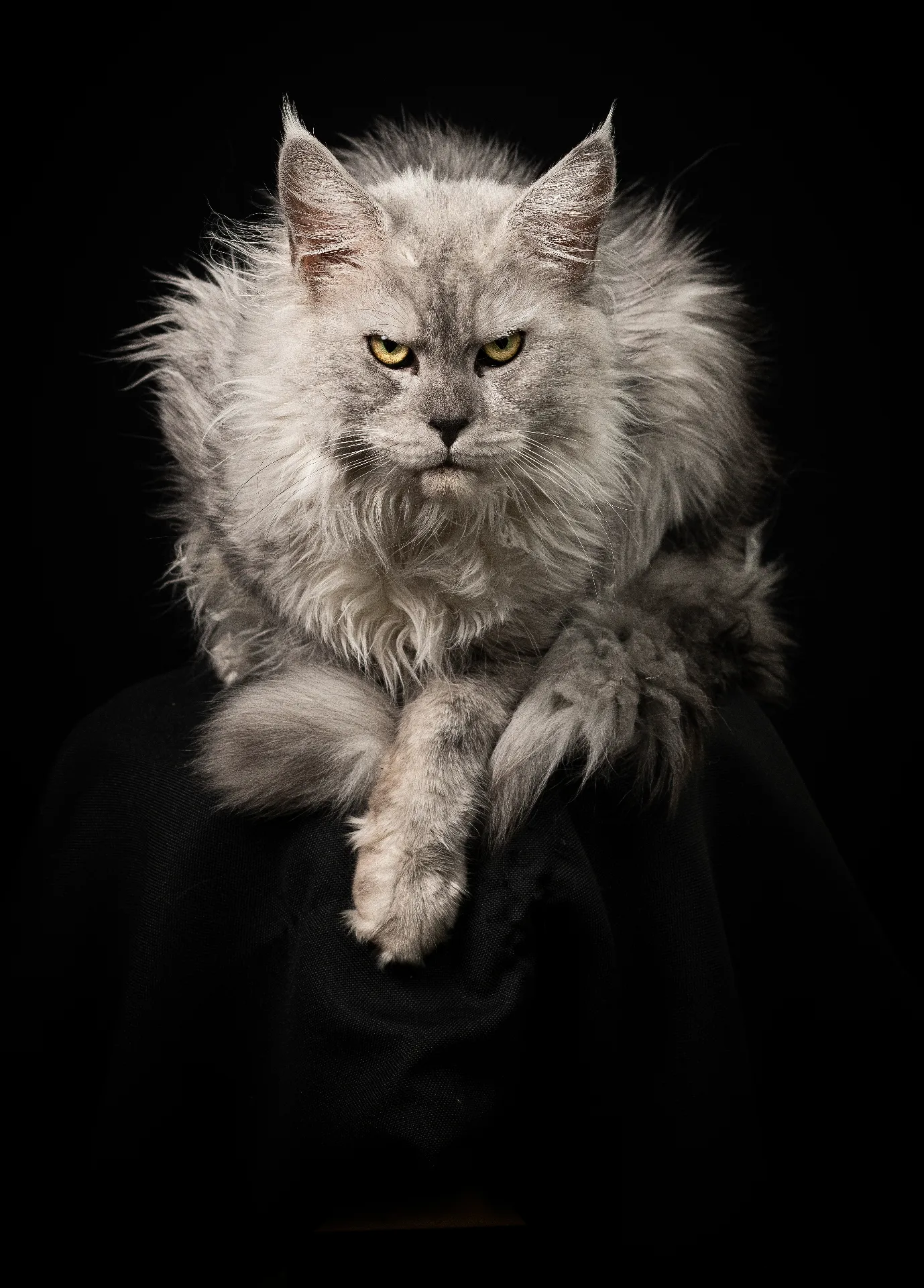
Maine Coons come in one of the widest color ranges of any pedigree breed — over 75 TICA-recognized color and pattern combinations. I live with this color diversity every day: Coco is a breathtaking blue smoke, Euro wears the bold brown classic tabby, Angel shimmers in silver tabby, Eddie commands the room in red classic tabby, and Libra is pure European white. Each of them looks like a different breed entirely — and that's part of the magic.
Understanding the Basics: Base Colors
Every Maine Coon coat starts with one of two base pigments: black (eumelanin) or red (phaeomelanin). All other colors are variations or dilutions of these two foundations.
| Base Color | Genetics | How It Looks | Common Variations |
|---|---|---|---|
| Black | Full eumelanin expression (B gene) | Dense, solid black from root to tip | Black smoke, black tabby, black tortie |
| Blue | Dilute black (dd gene pair) | Cool slate-gray; the dilute of black | Blue smoke, blue tabby, blue-cream |
| Red | Full phaeomelanin expression (O gene) | Warm orange-red; more common in males | Red tabby, red smoke, red solid |
| Cream | Dilute red (dd gene pair) | Pale buff or ivory; the dilute of red | Cream tabby, cream smoke |
| White | W (dominant white) or S (white spotting) | Pure white; masks all underlying color | Bicolor, van, harlequin patterns |
Smoke: The Most Dramatic Effect in the Breed
Smoke is arguably the most visually spectacular color expression in the Maine Coon world — and I'm biased here, because Coco is a blue smoke and she stops people in their tracks. A smoke cat appears to be solid-colored at rest — but watch them move, and a ghost of silver or white undercoat flickers through the fur like smoke. When Coco stretches or rolls over, that silver undercoat flashes through, and I still catch my breath every time. The effect is caused by wide-banded inhibitor gene expression: the lower portion of each hair shaft is nearly white, while the tips carry the full base color.
| Smoke Color | Base Color | Effect |
|---|---|---|
| Black Smoke | Black | Jet-black tips over brilliant white undercoat. The most requested smoke variety. |
| Blue Smoke | Blue (dilute black) | Silver-blue tips over white. Softer and more ethereal than black smoke. |
| Red Smoke | Red | Warm copper-red tips over white undercoat. Glows in natural light. |
| Cream Smoke | Cream (dilute red) | Pale ivory tips over white. Subtle and luminous. |
| Tortie Smoke | Black + red patches | Smoke effect across a tortoiseshell base. Extraordinarily complex and rare. |
The first time I saw Coco in sunlight — really saw her — the silver undercoat appeared and disappeared with every step, like a living shadow. I texted a breeder friend: "Is this normal?" She laughed. "That's smoke. You'll never get over it." She was right. — Dawna Marie
Tabby Patterns: The Original Maine Coon Look
The tabby pattern is the ancestral Maine Coon expression. In the wild, all cats carry the agouti gene that produces banding on individual hairs — but different pattern genes determine how those bands arrange themselves across the coat.
Classic Tabby (Blotched)
Broad, swirling whorls across the sides — often called the "butterfly pattern" because the markings on the shoulders resemble open wings. Bold, graphic, and unmistakable. Euro wears this pattern in brown, and his whorls are so dramatic they look hand-painted. Eddie carries it in red — imagine those same bold swirls in warm copper-orange. Two kings, same pattern, completely different energy.
Mackerel Tabby
Narrow parallel stripes running vertically down the sides, like fish ribs — hence the name. The most common tabby pattern globally. Clean and elegant.
Ticked Tabby
Individual hairs are banded (like an agouti or wild rabbit coat) but the overall body lacks strong striping. Often shows tabby markings only on the face, legs, and tail. Less common in Maine Coons.
Patched Tabby (Torbie)
A tabby pattern overlaid on a tortoiseshell base — producing a cat with tabby markings in both the black and red areas. Also called "torbie." Always female (with rare exceptions).
Tortoiseshell: Nature's Masterpiece
Tortoiseshell (or "tortie") cats carry both black and red pigment genes on their two X chromosomes — one for each color. Since the genetic expression is X-linked, torties are almost exclusively female. Males can only be tortie if they carry an extra X chromosome (XXY — Klinefelter syndrome), which occurs in roughly 1 in 3,000 male cats and results in sterility.
The color distribution in a tortie is determined randomly during embryonic development — the cells expressing each X chromosome are scattered unpredictably. This is why no two torties are ever identical. Every one is a unique, unrepeatable work of art.
What to Expect from Cocoa × Eddie Kittens
- Cocoa (black smoke female) × Eddie (red male) will produce black smoke males and females, plus tortoiseshell and tortie smoke females
- No two kittens in this litter will look the same
- Tortie and smoke torties from this pairing are among the most visually stunning color combinations in the entire Maine Coon breed
- Males will inherit Cocoa's black smoke or Eddie's red — females may receive both
Bicolor and White Patterns
The white spotting gene (S) introduces areas of white into any base color, creating bicolor, van, and harlequin patterns.
| Pattern Name | White Distribution | Characteristics |
|---|---|---|
| Bicolor | Approximately 40–60% white | White on face, chest, belly, and paws; color on back and top of head |
| Van | Mostly white (80%+) | Color restricted to head and tail; named after the Turkish Van cat |
| Harlequin | Mostly white with random patches | Large, irregular patches of color on a white body |
| Tuxedo | Black or colored body + white bib and boots | Not an official TICA category but widely used colloquially |
Silver and Gold: The Shaded Series
The inhibitor gene that creates smoke in full-banded coats creates a "shaded" effect in ticked (agouti) coats. The result: cats that appear to be dipped in a metallic color.
- Chinchilla Silver: Only the very tips of guard hairs are colored; the undercoat is pure white. The effect is a sparkling, almost metallic white coat with subtle shading.
- Shaded Silver: More pigment on tips than chinchilla; creates a more defined coloring with a silver mantle effect.
- Golden: Same mechanism as silver but on a warm cream/gold base instead of white. Rare and highly sought after.
Eyes, Nose, and Paw Pads by Color
Coat color and eye color are genetically linked in cats. Here's a general guide — though individual variation is common:
| Coat Color | Expected Eye Color | Nose Leather |
|---|---|---|
| Black, black smoke | Gold to copper | Black or dark brown |
| Blue, blue smoke | Gold to copper | Blue-gray or lavender |
| Red, red tabby | Gold to copper | Pink to brick red |
| Silver tabby | Green or gold | Brick red with black outline |
| White | Blue, odd-eyed (one blue, one gold), or copper | Pink |
| Tortoiseshell | Gold to copper | Mottled pink and black |
Does Color Affect Personality?
I get asked this constantly, and I'll give you my honest answer: there is no scientific evidence that coat color determines personality. People love to talk about "tortitude" and "ginger cat energy" — and I get it, it's fun. But in my experience raising litter after litter, it just doesn't hold up.
Coco is a blue smoke and she's the boldest, most fearless cat in my program. Libra is pure white and she's the calmest, most maternal soul I've ever encountered. Angel is a silver tabby and she's gentleness personified. Euro is a brown classic tabby and he's so social he's basically a golden retriever. Eddie is a red classic tabby with a commanding presence but the softest heart. Same breed, wildly different colors, completely individual personalities. I match kittens to families by who they are, not what color they wear.
Curious what colors our current litter will carry?
See Our Upcoming Kittens →