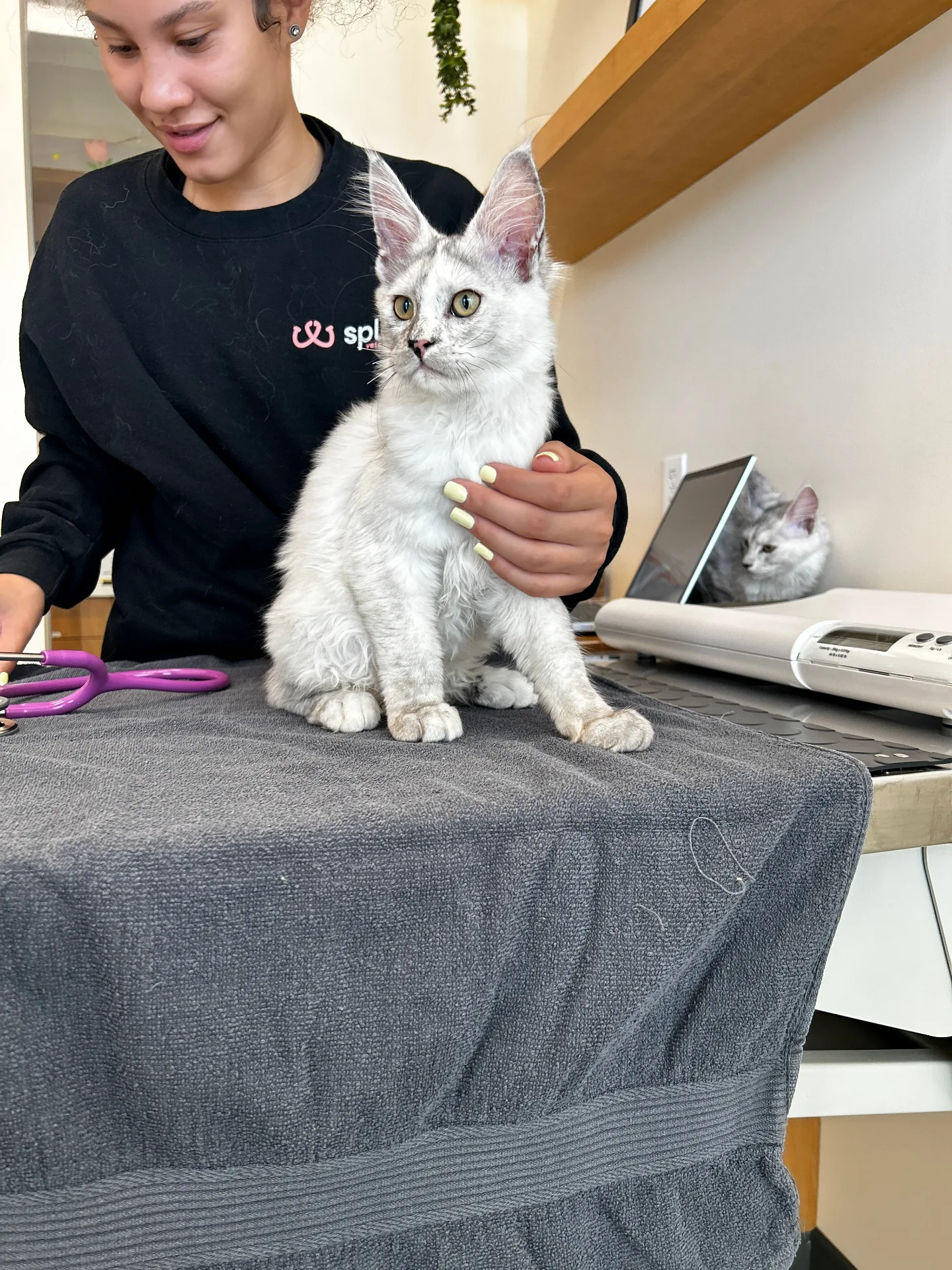
I tell every family the same thing before pickup day: find your vet before your kitten comes home. Not after. Not "sometime this week." Before. Because the right vet for a Maine Coon isn't any vet — it's a vet who understands that a 20-pound cat with a heart predisposition and a 5-year growth timeline is a fundamentally different patient than a domestic shorthair. I've learned this through experience, and I want to save you the same learning curve.
Why Maine Coon Veterinary Care Is Different
Maine Coons are not large domestic shorthairs. Their healthcare needs differ in several meaningful ways:
| Healthcare Need | Why It's Maine Coon-Specific | Frequency |
|---|---|---|
| HCM Echocardiogram | Breed is genetically predisposed to hypertrophic cardiomyopathy; DNA testing alone is insufficient | Annually from age 1 |
| Growth milestone assessments | Maine Coons grow until age 3–5; standard "adult at 1 year" assumptions don't apply | At every wellness visit until age 5 |
| Dental care | Breed is prone to periodontal disease; professional cleaning typically needed more often than average | Annual assessment; cleaning as needed |
| Blood panel — kidney values | Predisposition to kidney issues; establishing baseline early matters | Annual from age 2 |
| Weight management | Their large size can mask both underweight (looks normal) and overweight (hard to assess visually) | Every wellness visit |
The Chatlerie Veterinary Partnership: Sploot Veterinary
I chose Sploot Veterinary as our partner practice because they get it. They understand Maine Coons aren't oversized domestic shorthairs. They know about HCM screening timelines, they understand the breed's slower growth curve, and they treat my families like family. Every Chatlerie family receives a 15% discount on their first year of care at Sploot Veterinary. I hand you the referral code personally at pickup — it's part of the kitten kit, right next to the health records and the food your kitten has been eating.
What to Look for in Any Illinois Vet
Whether you're in Chicago, Naperville, Aurora, Schaumburg, or downstate Illinois, these criteria apply universally:
Vet Evaluation Checklist for Maine Coon Owners
- Experience with Maine Coons or large cat breeds: Ask directly. A vet who has regularly treated Maine Coons will understand the growth timeline, the HCM prevalence, and the breed-appropriate weight ranges.
- Access to board-certified cardiologist for HCM echo: Your primary vet doesn't need to perform the echo themselves, but they need an established referral relationship with a cardiologist who does. Ask: "Where would you refer me for an annual HCM echocardiogram?"
- Cat-friendly certified (AAFP) or cat-only practice: Reduces stress considerably. Cats who smell dogs in a waiting room are already stressed before the exam. Cat-only practices or those with separate cat entrances and waiting areas are strongly preferable.
- Comfortable with large cats: Adult male Maine Coons can reach 25 lbs. A vet who hasn't worked with large cats may use undersized equipment or have difficulty with physical examination. Ask about their largest feline patients.
- Open to long-term relationship: Your Maine Coon will be with you for 15+ years. You want a vet who will know your cat's history, track their baseline values over time, and flag changes that a new provider would miss.
- Transparent about HCM protocol: Ask: "What is your recommendation for HCM screening in Maine Coons?" A vet who says "just the genetic test" is not current on the literature. The standard is annual echo by a cardiologist from age 1.
HCM Specialist Access in Illinois
The annual HCM echocardiogram should be performed by a board-certified veterinary cardiologist, not a general practitioner. Illinois has several veterinary cardiology practices, primarily concentrated in the Chicago metropolitan area and at university teaching hospitals:
- University of Illinois College of Veterinary Medicine (Urbana-Champaign): Full cardiology department with HCM screening experience. Worth the drive for an annual echo if you're in central or southern Illinois.
- Chicago-area specialty and emergency centers: Several AVMA-accredited specialty practices in the north, northwest, and southwest suburbs offer cardiology services. We can provide current referral recommendations at pickup.
- Ask your primary vet for their referral network: They should maintain a relationship with a local cardiologist. If they don't, that's worth knowing before you commit to the practice.
Your First Vet Visit: What to Bring
I put a lot of thought into the health packet every Chatlerie family receives at pickup. It's not a folder of printouts — it's the documentation of every investment I've made in your kitten's health. Here's what you'll walk into that first vet visit with:
- Vaccination records (FVRCP completed per our schedule)
- FeLV/FIV negative test results
- Wisdom Panel genetic test results for both parents (Euro, Coco, Angel, Libra, or Eddie — depending on your kitten's lineage)
- Most recent HCM cardiology reports for both parents — dated and signed by the cardiologist
- Deworming history
- Our written 3-year health guarantee
Bring this entire packet to your first appointment. I've had vets call me to say they've never received this level of documentation from a breeder. That's exactly the point. A good vet will review the parent health records, note them in your kitten's file, establish a baseline weight, and schedule the next vaccine appointment. This first visit should happen within 72 hours of pickup — it's both good practice and a requirement under our health guarantee.
A note on vaccine recommendations: Some vets will recommend annual FVRCP boosters indefinitely. Current AAFP guidelines suggest a 3-year booster interval for indoor-only cats after the initial series is complete. Discuss this with your vet and ask about their reasoning — a vet who can explain the current guidelines demonstrates they're keeping current with the literature.
Pet Insurance: Before the First Visit
We recommend enrolling in pet insurance before or on the day your kitten comes home — ideally before any vet visit. Most policies have waiting periods and exclude pre-existing conditions. A kitten who visits the vet before being insured may have that visit documented as a pre-existing condition. The time to buy insurance is when your kitten is perfectly healthy and has seen no vet.
We'll connect you with our vet network at pickup. Join the Chatlerie family.
Start My Application →