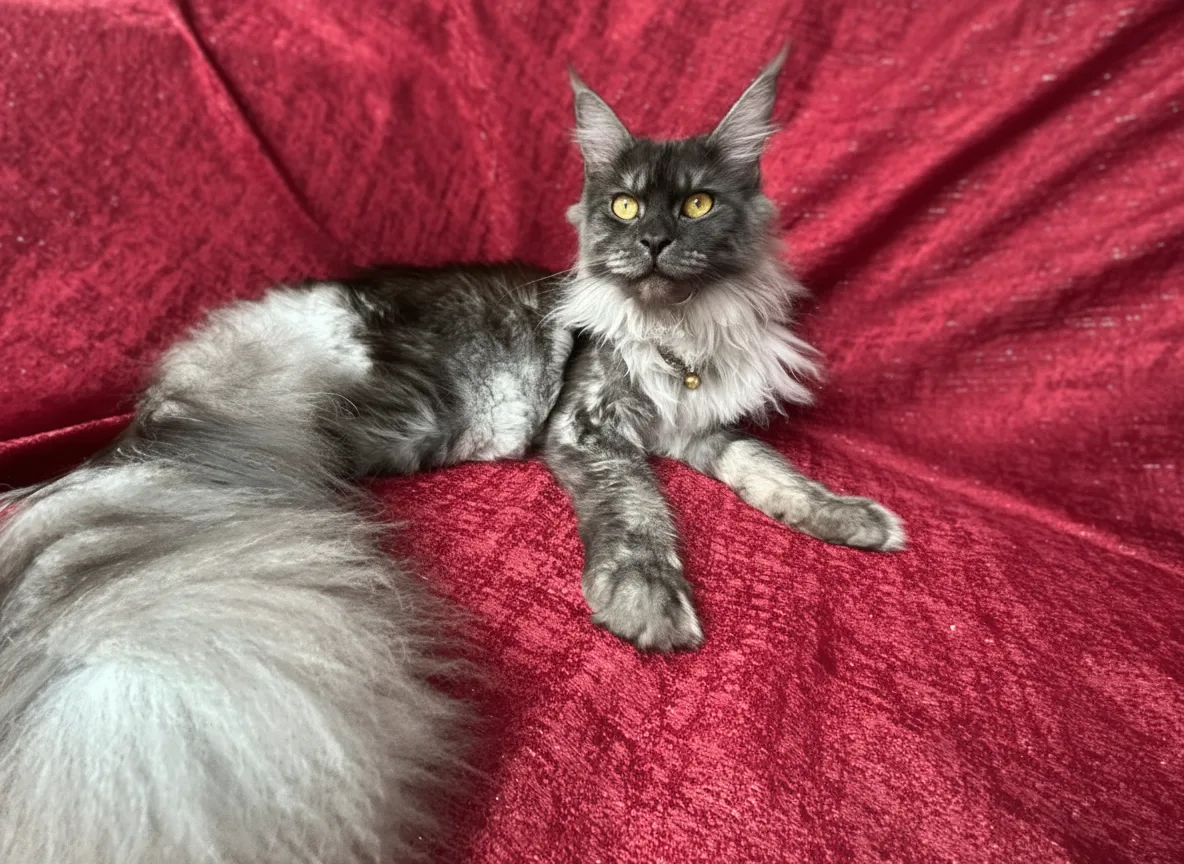
As a breeder, we recommend pairs more often than people expect. Maine Coons are intensely social animals who thrive with companionship — and a second cat often solves behavioral issues that no amount of toys or puzzle feeders can address.
Why Pairs Work
Social needs. Maine Coons were not designed for solitary life. They need interaction — hours of it, daily. If you work outside the home for 8+ hours, a single Maine Coon spends most of its waking life alone. A second cat provides the social stimulation that you can't offer during working hours.
Energy management. Two kittens wrestle, chase, and play with each other, burning energy that would otherwise be directed at your furniture, your curtains, and your 3 AM sleep. The kitten who's destroying things out of boredom is the kitten who doesn't have a playmate.
Socialization. Cats raised with other cats develop better social skills. They learn bite inhibition, play boundaries, and conflict resolution from each other in ways that humans can't teach.
Easier transitions. Two kittens arriving together in a new home have each other as a security anchor. The adjustment period is typically smoother than for a solo kitten, who must navigate the new environment entirely alone.
When Two Isn't Better
You already have a resident cat. Adding one new kitten to a household with an existing adult cat is usually easier than adding two. Two newcomers can form a coalition that overwhelms the resident cat socially.
Budget constraints. Two cats means double the food, litter, veterinary costs, and pet insurance. If the second cat's expenses would stretch your budget uncomfortably, one well-cared-for cat is better than two underserved ones.
Very small living space. Two large Maine Coons in a studio apartment can work but requires exceptional enrichment and vertical space. Be realistic about your square footage.
The families who adopt pairs almost always tell us the same thing six months later: "We can't imagine having just one." The cats entertain each other, comfort each other, and create a dynamic that enriches the entire household.
The Logistics
Same litter is ideal. Kittens from the same litter have already bonded. They know each other's play style, they've established their relationship, and the transition to your home is seamless. We offer pairing discounts because we genuinely believe it's better for the cats.
Different litters work too. Same-age kittens from different litters integrate quickly — kittens are naturally social and adaptable. The integration period is typically 1–3 days of cautious exploration followed by full-speed wrestling.
Male-female pairs are often the smoothest long-term combination. Two males work well if both are confident and social. Two females can occasionally develop subtle tension, but well-socialized Maine Coons rarely have serious inter-female issues.
Cost Reality
Annual Cost Comparison
- Food: ~$600/year per cat → $1,200 for two
- Litter: ~$300/year per cat → $600 for two
- Vet (routine): ~$300/year per cat → $600 for two
- Insurance: ~$400–$600/year per cat → $800–$1,200 for two
- Total additional cost: roughly $1,600–$2,700/year for the second cat
The question isn't whether you can afford a second cat financially. It's whether the investment in a second cat delivers enough value in reduced behavioral problems, happier cats, and richer family dynamics. For most families, it does.